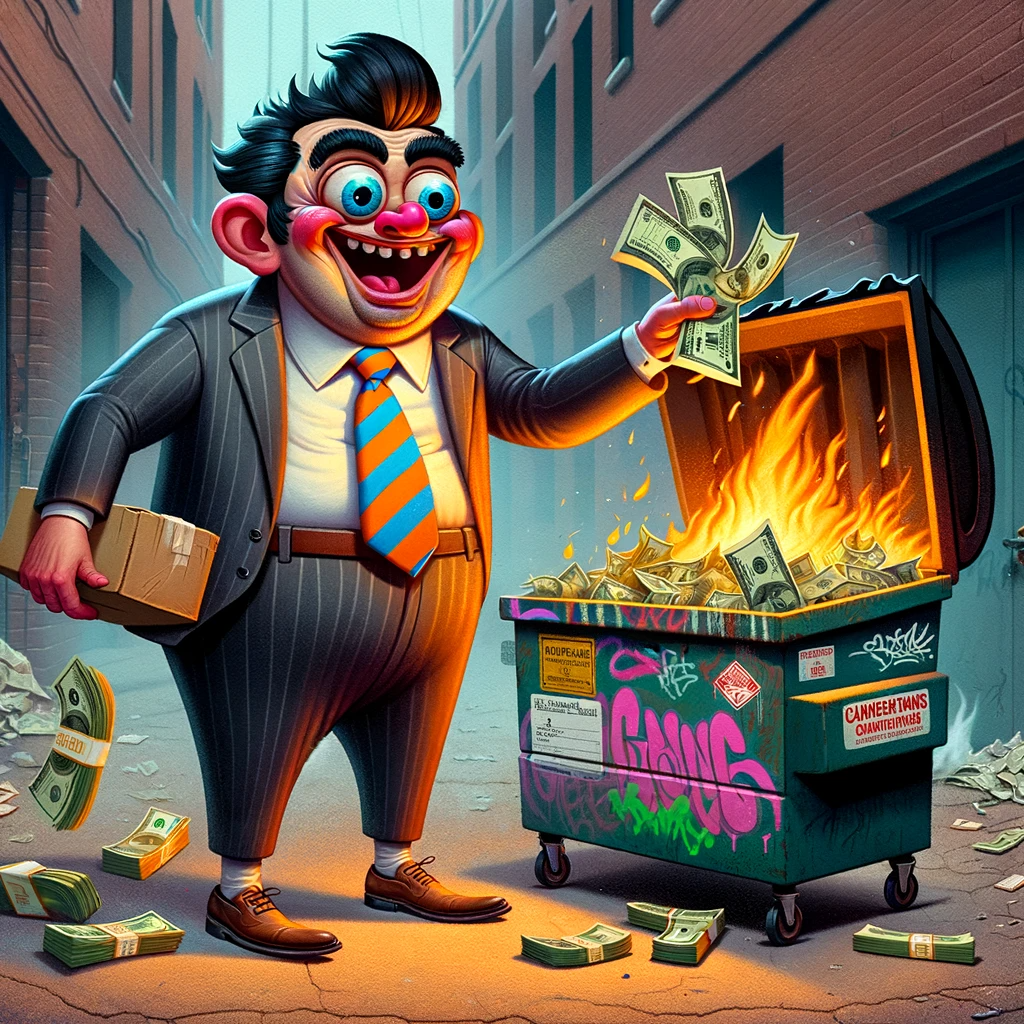
Buying businesses is all the rage these days. You’ve seen the gurus. Move over, real estate! Young would-be tycoons can get their start with a new strategy. The promise of buying cash flowing real estate with zero money down may have proved illusory, sure. But now there’s a new way to get rich! Buy a successful business for zero down! The new finance experts on social media are all about buying businesses from retiring boomers, or whomever. Sounds like a lock!
All jests aside, buying a business is a legitimate way to build wealth. But there are a lot of caveats. If you’re looking to manifest your way to wealth through buying companies, especially online, this story of acquisition pain is for you. So before getting on BizBuySell or googling “Business For Sale,” take a minute to read this cautionary tale. As Charlie Munger said, a great way to suffer and fail is to learn only from your own mistakes and not those of others.
This story is an opportunity for you to learn some valuable lessons from my mistakes. You can take actionable learnings from it, which will serve you in your own journey. It is a story of hubris, overconfidence, failure and crushing disappointment. And a little success.
Many of you will find the whole story interesting. But for you stern no-nonsense types who just want the action items, the summary of my learnings is at the end of the article. Use the time you saved to do a cold plunge and read Epictetus. Or whatever it is you all do.
A disclaimer. I don’t blame any gurus for my mistakes. I got into this business at the top of a bubble I didn’t know existed. I came to this idea all on my own. It wasn’t until after I was well underway that I realized there was a whole business buying grift going on on the interwebs. (That’s a lesson in and of itself. Before you dive into something, take the lay of the land, and see what you can learn from what people have already done. No need to reinvent the wheel!)
Background
A little background. Before diving into acquisitions, I was a co-owner in a roofing company. I had owned a side-gig Amazon store since 2016. It was profitable, but never scaled past low 6 figures. I owned it with a partner and old friend, who had a separate Amazon business of his own. In summer 2022 we decided we wanted to go all in on ecommerce. We figured that since you could buy Amazon stores for 2-3x earnings, maybe it made more sense to just buy larger stores than try to force growth in our own. And just doing some simple math, 3x earnings was a 33% ROI. So that’s pretty great, right? Well…
We decided to raise money from investors (friends, family, business associates). We wanted to buy Amazon companies! We figured that, since we both had 5 years of Amazon experience, we were well qualified. I also had 3 years of other business experience owning the roofing company.
As we researched the opportunities, we became aware that there were large companies already doing ecomm rollups. People called them “aggregators.” We also heard that they had slowed down in 2022. This was because of interest rate hikes and operational challenges. Silly geese. We were raising equity, and we were top tier operators, so these issues didn’t affect us. Their loss was our gain!
We thought we could do a good job of running these companies while continuing to do our other jobs. At the outset, I was still full-time in the roofing firm. My partner was working full-time as a project manager for a construction firm. We thought we had Amazon pretty well figured out. In our experience (with tiny stores), it wasn’t very time intensive.
Amazon Acquisitions
In late 2022 we bought two small Amazon stores. Both were #2 in their category at the time. Both had lopsided inventory positions exceeding their trailing twelve month profit. Both had no unique selling proposition. They were “me too” products. We paid around 2X earnings for both. We financed the inventory on a seller note. We paid it back as inventory sold through. We paid $239k for the first brand and $325k for the second.
In Q1 of 2023, it became clear we were in choppy water. Cheap Chinese competition flooded both markets. At the same time, consumer spending was softening. The result was a cratering of both revenue and profit, leaving almost nothing on the bone. (More details on this in the Amazon article.)
Over the spring, this trend continued. We tried to save both brands by testing DTC, but none of the ad campaigns would scale. The products were too generic, and the demand was on Amazon. By the end of 2023, both companies were dead.
Over the summer and early fall, I made another unforced error. I put personal money into both failed brands. It should have been clear by late spring that they were both dead. The violent downward shift in revenue and profit should have signaled something was very wrong. But I was unwilling to accept this, and instead poured money into them trying to save them. I put about $55k of my own money into the two brands. I tried to save them by hiring agencies, running ads, and floating inventory. I wouldn’t face the facts because, well, they had to work out. I couldn’t lose my investors’ money. So I committed a classic sunk cost fallacy and threw good money after bad. But it turns out the market doesn’t care about your demands. You can’t will a shitty company into profitability. But you can waste a lot of money trying.
Fallout
My investor in company #1 was my partner in the profitable roofing company. I traded him my shares in that for his now worthless shares in the acquisition, making him whole. We had financed company #2 with a bank loan secured by my family’s property. I took on the note payments to ensure they would suffer no losses. So at least thus far, we have been able to bear the brunt of the losses ourselves.
A lot of external factors and internal mistakes came into play with the Amazon brands. I have a separate article breaking down the details of those. It also covers the learnings specific to Amazon brands. For the sake of this story, the relevant takeaway is that there were lots of red flags, had we known to look for them. These were avoidable mistakes.
So much for Amazon brands.
Buying DTC Brands
In December 2022 we were still optimistic, despite initial rockiness on Amazon with the first two brands. We were looking for more acquisitions to fill out our budding ecomm portfolio.
A broker we had worked with before reached out with a deal he thought we would like. It was a DTC Shopify store doing about $60k/mo in profit. It had only been operating since March, so the asking multiple was low. Amazon might not be the thing anymore, but hey, DTC looks promising! Wouldn’t it be nice to be in charge of our own customer acquisition?
We talked to the seller and built good rapport. We liked the company. We negotiated a deal where we paid $730k up front for the store and another $150k in an earnout. We structured the earnout so that if the store exceeded the $60k/mo profit benchmark, everything above that would go back to the seller. This would continue until he got the full $150k. The seller also agreed to stay on until the end of the year to run the marketing. This was critical, since we had no knowledge of DTC customer acquisition.
We raised $730k of equity from business colleagues. We financed about $76k of inventory on a seller note.
The first 2 months were excellent. The store outperformed, doing well over $100k the first two months after we bought it.
Trouble
Then it softened. Some of this was the volatility inherent to ecommerce. Some of it was due to an error on our part putting the brand on Amazon (more about that in my article on how to fail at DTC). But it revealed an underlying weakness.
The product we were selling was… wait for it… generic. Our only advantage was that a lot of people didn’t know about it and needed help using it. So it was really a service company disguised as a product company. But the service was garbage.
The previous owner had set up the ops side of the company like most dropship bros do. Although better organized. No phone support. Couple of VA’s using generic scripts. No real customer service. At this point, the company had been in business for about a year and the poor service was catching up to it. Negative reviews had started to pour in. Had we not fixed it, it would have killed the company.
My partner spent the next 4 months handling customer service himself to figure it out. He built out SOPs that allowed us to hire a talented person in India to take over phone support. Customer support is now a huge asset for the brand. So that was a win, costly as it was.
While auditing customer support, we discovered that a lot of the ads we inherited from the seller were bad. They made misleading and sometimes even false claims. So we had to change the ads. This disrupted the ad campaigns, causing further friction.
But, we started to right the ship. We were getting better reviews, we had fixed the ads, and they were doing ok. Things were looking decent again.
The Hack. And Agencies
In May, hackers got into our Facebook business manager. They kicked us out for two weeks and spent about $136k on their ads. We had Amex, so we recovered the fraudulent spend, but it took us 2 weeks to get the account back. So in that time we had very little revenue.
As a result of the hack and the false ads, we had lost some faith in the seller. At the same time, an ad agency came knocking who wanted to run all our ad accounts. We figured that with professionals in charge the account would be more secure. And of course performance would increase.
Boy were we wrong! I have a more detailed breakdown here about why agencies almost never make sense for ecomm brands. The short version is they just turned the same ads back on. They tried to scale them as lazily as possible. This resulted in a massive decrease in efficiency. And on top of that we had to pay princely fees for the privilege of having them wreck our efficiency. So that ruined two months’ worth of P&Ls.
In early October we decided to do all the creative and media buying ourselves. We were on a steep learning curve, but in November we had better ad performance than under the agency. I am fortunate that my partner is the best person I know at learning complex information and turning it into action items. So despite the immense learning curve, we’re still doing better than under the agency.
This company is now doing less than half of the profit it was doing when we bought it. Projected payback for investors has gone from 15 months to 30 months. Overall, it’s still a good investment, and I would do the deal again. But the errors we made took a huge bite out of the expected return.
So much for Acquisition #3.
More DTC Tomfoolery
But we’re gluttons for punishment, so we weren’t done yet!
In September 2023, we came across an opportunity to buy a distressed business. The sellers had started the company in May and scaled up fast. It had made over $100k in profit in August. They needed to sell in a few weeks because they had a large tax lien they had to pay within 30 days.
We offered them $250k upfront, which would take care of their tax lien with a little extra. After we paid investors off, they would be able to keep a meaningful percentage of the profits. We tiered the percentage based on performance. This would be in exchange for staying on to run the marketing. We would take over the ops. We thought it was a fair deal given the risk profile of the business.
We ripped through due diligence. We verified all the numbers and did an in-depth audit of their customer service. They had many complaints about shipping speed. They were dropshipping and their Chinese forwarder sucked. We figured this was an easy fix as we intended to put stock in the US for domestic fulfillment.
Because of the shipping time, we weren’t able to try the product (a men’s hair product) before they needed a decision back. But since they had very low charge backs and most customer inquiries were about shipping, we figured it must be decent.
Crisis
Right after closing, the store performance tanked. Tik Tok had restricted their page for duplicating too many ads. Their FB feedback score had dropped because of negative shipping feedback. At first, we weren’t worried. They had warned us about the ages and they were setting up new ones. But the decline continued for the next two weeks. The average revenue went from $10k/day down to $1k/day over about a week.
3 weeks in, we confronted them on this and learned that they hadn’t been running the ad accounts at all! They had taken full-time jobs elsewhere.
My partner and I found ourselves holding the proverbial bag. With no prior creative or media buying experience, we jumped in. As mentioned before, my partner is awesome at digesting complex information and synthesizing it into an actionable system. So despite the learning curve, he has been able to pick up the ads skills in a short time, and manage that part of the business. The ad accounts started to recover.
However, we learned that the product was not as good as we thought. So we iterated on it and made a better version. And pivoted the old stock to a use it was more suitable for. We are now overhauling and rebranding. We have better products, more accurate ads, and better fulfillment. Rebuilding the company from the ground up, for all practical purposes. Not what we planned, but better than total failure. And we are cautiously optimistic for the brand, as there is clear demand.
In summary, we realized too late that the sellers were short-term dropship bros. They set up fly-by-night stores to make a quick buck from trends. In this case, they stumbled on a large pocket of stable demand. This shows that there is an appetite for a product like this. If it’s good. They didn’t capitalize on it because they didn’t build for sustainability. Instead, they aimed for quick profits. They demonstrated high time preference, to their detriment and ours.
That’s acquisition #4.
Summary and Learnings
So here we are,15 months from our first acquisition. What are the results? What did it cost? What did we learn?
The results? 2 companies died on the operating table. One is underperforming. We’re rebuilding the fourth.. We are (I hope) wiser, and have acquired some skills and knowledge in ecommerce.
The cost? We went from having a decent financial base, strong income and some assets, to having neither. We are in a precarious financial position. It looks like it will be fine in the medium-long term, but it’s not pretty in the short term.
Most importantly, what do we learn from this experience? What can you take away and apply to your own ventures?
Some lessons are ecommerce specific. I’ll go into those in more detail in my Amazon and DTC articles. But some lessons apply to business broadly. Here are eight I’ve distilled from this experience:
- Product is primary. Start with value. What value is this offering the consumer? How is it different from alternatives? If you’re going to buy a company you need to be able to answer this or you’re headed for a world of hurt. Surviving market headwinds and random misfortunes depends on strong product market fit. It also relies on some level of competitive moat.
- Corollary to #1 – Don’t buy the financials. Buy value. A low-value-add ecomm “brand” can put up a good year or two of financials riding a wave. But competition or a down market will can erode their position. Historical data is only useful if you have a compelling reason to be certain that the brand will continue to enjoy the same tailwinds. If the business is generic, you can compete with it for a lot less than purchasing it, unless you get a screaming deal.
- Your value add must be in-house. Where does the company provide value? You need to understand that function and execute it. For most ecomm “brands,” the product is not patented and it comes from China, so your real value is marketing. If that’s the case, you need to OWN that.
- Get a lot more granular and conservative when figuring your return/payback period. I go into more detail on how here. If you’re an entrepreneur, your “conservative” projections are wildly optimistic. It’s how we’re wired. Get a risk-averse type to analyze your deal and give you their thoughts. Spend some time focusing on the downside and asking “does this deal still make sense if X happens,” and “how likely is X?”. Use that to help inform the payback period you’re willing to tolerate.
- Before acquiring a company, understand the industry’s basics first. You need to understand what makes the company and category tick. What’s the unique selling proposition? How do they get customers? What are the threats to customer acquisition? What are the risks and volatility native to that industry? What skills will you need to have or employ to continue or grow the company’s performance. What do those skills cost?
- Don’t assume other people share your values. I think win-win for the long term. I’ve come to learn that a lot of people in business (especially small ecommerce) do not. But they are natural born salespeople, so they can put on a hell of an act! Even if you align incentives, you must set up the deal so that you will be ok if your counterparty fails to hold up their end.
- Look failure in the face early and often. You need to be on high alert for signals that things are going south. If the brand violates your expectations in a big way, that’s a strong sign that the fundamentals have changed. I would have known by late spring that the Amazon companies were toast had I been willing to look at the facts. When the fundamentals change, you need to go back to the drawing board and reevaluate. Is this still a good deal? Or is further effort and expense throwing good resources after bad?
- Run away from FOMO! Under no circumstances should you make decisions motivated by fear, desperation, or greed. This is the most important lesson of all. You could argue that I should have known lessons 1-7 without having to lose my ass. None of them are occult knowledge, and I’d been in business long enough to be aware of them. So why wasn’t I paying attention to those realities when making decisions? I go into detail elsewhere on how I analyze mistakes to get at the root cognitive errors that caused them. Doing this exercise, I realized I had a false sense of urgency when making these deals. I felt like I “had” to make something work. I had many deep-seated negative beliefs about myself. I felt that any prior success was due to luck. I had no real skills, and it could all fall apart any minute. So I had to take whatever opportunities I had to get something else going, right? This meant I couldn’t make a sober judgment of the risk. On a nervous system level, I felt like it “had to work.” So, my brain didn’t want to look at any of the things it knew could impinge on doing deals. As a result, all my hard-won knowledge from prior experience was unable to come to my aid.
Those are my takeaways, and I’ve adjusted my decision making process accordingly. Have I learned the right lessons? Time will tell. And I hope some of you will weigh in and give me your thoughts. Heap derision upon me if you like. I deserve it.
More to follow soon.
Good luck out there. Stay safe, and stay solvent!
 The Very Failed Blog
Leave a comment