So you want to buy an online business? Good for you. You have courage and optimism, fine qualities in an entrepreneur.
Qualities that also set you up to lose your shirt. Entrepreneurs’ natural optimism often causes us to overlook risks. We think we’re being “conservative” when we’re actually making insane gambles.
That was the case for me at least. Luckily, you can learn from my mistakes. This way, you can get after it, while knowing what pitfalls to look out for. This way, you don’t lose the farm.
As a budding private equity mogul, you’ve likely spent some time surfing business listing sites. On these sites, the sellers or listing agents have helpfully included a metric called a “multiple.” It expresses the ratio between a company’s profits and the asking price. Convenient. Using your private school math, you might have been excited to realize that a 3x multiple on profit must mean that the ROI on this deal is… a whopping 33.33%?
Look out Warren Buffett, here we come!
Not so fast. This article will show why so-called “SDE multiples” are deceptive. I will also share how a would-be acquirer should approach the valuation of an online business. In my humble opinion.
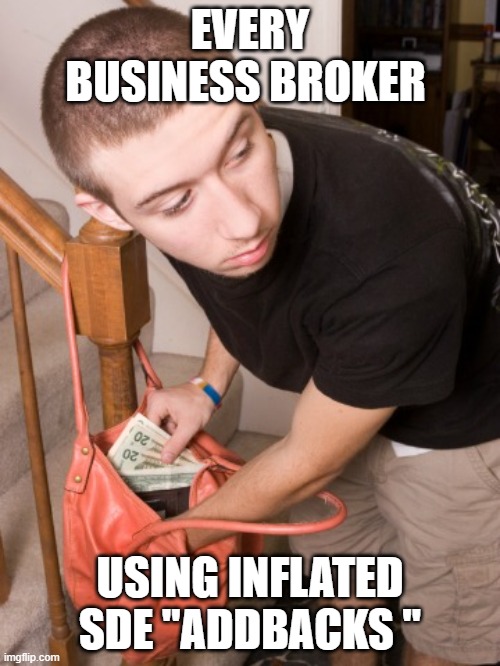
But first, what is SDE? SDE is M&A speak for profit in a small business. It stands for “Seller’s Discretionary Earnings.” It attempts to represent the full financial benefits available to the owner of the company. You arrive at SDE by taking the taxable income of the business in the trailing twelve months. Add back the owner’s salary, benefits, and any “one-time” expenses that the business doesn’t expected to incur again. The idea is to show the buyer all the benefits he can enjoy in the following twelve months if he buys the company. Now you might be thinking “wait, so it counts the operator’s salary as ‘profit’? Am I buying a job??” In most cases, yes you are. And that’s part of the problem with SDE.
Below, we’ll get into the details of what else is often missing in these SDE multiple calculations. This can change a deal from being attractive on the surface to perilous in reality.
Inventory
In e-commerce, (as distinct from SaaS or content businesses), we sell physical goods. This means that the profit that you see on a company’s bottom line is dependent on inventory. As you grow your revenue and profit, your inventory must grow as well. In the subtext of those listings mentioned above, you will normally see “plus inventory” slipped in after the asking price. But if that revenue and profit are dependent on inventory, why is it listed like it’s an optional add-on? Same reason we don’t show sales tax and shipping immediately when a customer adds to cart on our website. Good old fashion marketing and conversion rate optimization. Brokers are salespeople after all!
When buying a business, we need to add the total cost of inventory to the list price to get the real asking price. We also need to evaluate the inventory position. If it’s heavy, say more than 90 days worth (in most cases), we need to ask why. We don’t want to buy inventory that’s not selling through or is likely to cost us long term storage fees.
Working Capital
How much working capital do you need?? You don’t add this to the asking price. Instead, it’s part of your internal calculation of your all-in cash. You use this to determine your ROI and ROE.
This would include additional inventory purchases you’ll need to make in the first 30 days. This is especially relevant if their inventory position is low or the brand is growing. It would also include the cost of any improvements you need to make at the outset. (Web redesign, chat bots, ADA compliance etc.)
Add-Backs
As we saw earlier, it’s customary for sellers to add back any owner benefits or one-time expenses. Take a close look at these. Are the “one-time expenses” in fact one-time? Or are they reflective of the inherent volatility of the market which you will also face?
Owner benefits include salary, healthcare, personal vehicle, phone etc. Whether these add-backs make sense for you to include in your internal calculations depends on how you’re buying the company. If you don’t have outside investors and plan to run everything yourself, it could make sense. This is assuming you value your own time at zero. I say this because counting what would be your own salary towards profit skews your return on equity. It’s not a return on equity anymore. Now it’s a return on equity plus your time. This might make sense for you, but go into it with your eyes open.
You also have to ask: Will I be able to do everything the seller is currently doing as well as he is doing it? If you’re new to the industry, probably not. And if not, you may have to hire help to do some of what he was doing. If so, you should deduct that cost from the profit for your ROI/ ROE calculation.
Sales Tax
A lot of small online companies aren’t collecting sales tax according to law. This is because the time/labor burden to set it up is onerous, and hurts your conversion. The law of supply and demand means that you can’t charge more and still get the same outcome. And it doesn’t matter whether the charge originates with you or with the state. The customer makes the decision based on the total cost of the transaction.
In this case, you need to figure what the sales tax burden would be and deduct that from the top line revenue. You have to assume that you can’t tack it onto the sale price and get the same conversions. So all that money is coming out of the company’s bottom line.
This is controversial, but it’s my position if I’m a buyer. Sellers, get your sales tax sorted before you try to sell so you don’t have this issue!
Volatility and Platform Risk
E-commerce is risky. Most online businesses get customers one of two ways. Either they drive their own traffic from paid channels, or they use platforms like Amazon for customer acquisition. Both involve substantial risk.
Paid traffic from sources like Facebook ads is notorious for its volatility. Facebook restricts accounts without reason or warning all the time. Bugs can disrupt ad delivery and tank performance. Third party software providers can wreck your checkout with bad updates. New entrants to the market can pop up overnight and take market share. (This depends on your competitive moat, but most online businesses have little or none. If you’re drop shipping, your moat is zero). So the traffic an online store gets is not like the traffic a brick-and-mortar store gets. Foot traffic is unlikely to change unless the surroundings change. Online traffic can disappear overnight.
More risky even than paid traffic is the risk of having a large part of your revenue come from platforms like Amazon. You don’t have to search too hard in the e-commerce ecosystem to find hundreds of horror stories. The capricious Amazon algorithm eradicates brands overnight or hamstrings them beyond repair. Without cause or warning. The bottom line is, they control the business, not you. That doesn’t make it a bad easy to sell, it means you need to understand the risk going in.
It’s also worth noting that amazon exists to commoditize products for buyers. This means they make it as easy as possible to identify and compete with successful products. Competitive risk is the primary factor on Amazon. If your product isn’t unique and defensible, with IP or a large operational moat, Amazon bros or the Chinese will copy it in no time. This will drive the margin close to zero. Best case scenario you should plan on 20% attrition per year on Amazon. Most brands deal with this by adding new products on a regular basis. This can work, but you have to understand going in that you’re not buying an asset that will grow on its own. It won’t even maintain itself. You are buying a stone of Prometheus which you will roll up the Amazon hill until it dies or you sell the business.
Now, if you have a wonderful and unique product or brand that is defensible, Amazon is a great way to get in front of a huge pool of high-intent customers.
In the context of valuing a brand to buy, there’s not a single calculator for how these risks should affect your offer price. But you need to consider them when thinking about how long a payback period you’re willing to accept.
Free Cash Flow
In e-commerce, profit on paper does not equal cash flow. For paying debt service or investors, the only thing that matters is cash that you can distribute. For paying your own living expenses, the only thing that matters is cash that you can distribute. Paper profits don’t put food on the table, they inflate your tax bill.
It’s important to scrutinize the seller’s financial statements. Determine the free cash flow you can expect to distribute monthly or quarterly. Because until you sell, (and don’t count on that, it’s a sure-fire way to make bad decisions, ask every aggregator ever!) free cash flow is the only thing that matters.
If you’re buying the business with debt, you need to figure debt service as well. If you’re relying on it for your primary income, make sure the net after all expenses is about double what you need to live. This way, you have plenty of margin for volatility.
How to Determine A Valuation
It’s important to be unemotional here. Don’t let your excitement, or FOMO, or your chemistry with the seller, or any other non-quantifiable factor get in the way of coming to a valuation that represents a tolerable risk for you. That number is something you will have to live with in the long-term.
It’s important to understand that the amount you are willing to pay for a business is not connected to the asking price or the rest of the market. If someone else is willing to take more risk, or has a strategic advantage you don’t, (or has investor money burning a hole in their pockets!), that should not influence your valuation. This will without a doubt mean that you make a lot of offers that don’t get accepted. But that’s good, because it’s saving you from doing a lot of bad deals. It’s the seller and the broker’s prerogative to sell their business for the highest number they can. It’s your job to make sure you don’t ruin your financial future with a bad deal.
When I look at a potential acquisition now, I no longer look at it as a percentage return on investment. It’s too easy to look at those numbers and get greedy.
It’s better to think about it in terms of payback period, i.e., how long it takes you to get your money back. Ask yourself this question: How long am I confident that this business will continue to produce free cash flow? If the market does all the nasty things markets do, how long will this business last?
How long you’re willing to extend the payback period will depend on how you feel about the business overall. It will also depend on how you feel about the competitive moat it enjoys (or doesn’t). It also depends on your risk tolerance. At the end of the day it’s a judgment call. The longer the payback period you can tolerate, the higher upfront price you can offer..
So how do we calculate the valuation? A little private school math:
TTM Free Cash Flow x Payback Period (Years) = Upfront Offer Price
The DEAL
Now. Your private school math might have you thinking that this doesn’t line up very well with any of the asking prices you’ve seen. And you’re right. It doesn’t. That’s because 99% of deals listed right now are disastrous for buyers. They are the result of sellers still living in the heyday of the aggregator bubble. Despite those days being gone forever, asking multiples have been slow to come down. And even when they do, it’s unlikely they will adjust to reflect inventory and the other factors we saw earlier.
Sellers are emotionally connected to their businesses. They falsely connect the amount of work and love they have poured into it with the value it can provide to a buyer. All entrepreneurs are weak at accounting for risk. This is doubly true when they are trying to offload that risk onto someone else.
So how do you ever make a deal work?
This is where you earn your money. (You didn’t think acquisitions would be easy did you?)
It’s your job to build rapport with the seller. Put yourself in his or her shoes. Then, try to put together a deal that makes sense. Assuming they don’t have a strategic trying to acquire them, and assuming the dumb money doesn’t come sloshing back into the marketplace, you should have a good shot. Approach the deal with empathy and integrity.
It is my opinion that you shouldn’t budge on your max upfront offer. You should base that on your personal risk tolerance. Do not let a seller or broker talk you out of it. But, I believe you can and should be very generous in offering an earnout. The way I think about it is this: we both want to protect our downside and have some upside. Cashing the seller out takes his chips off the table and removes downside. But a straight cash deal also removes further upside. A lower amount upfront reduces your downside if things don’t go well. However, if things do go well, it may leave the seller feeling he made a bad deal. The solution is to offer the seller an additional “earnout” above the initial price. You” base this payout on the ongoing performance of the business.
The seller says it’s a great business, poised for growth (100% of the time.) Ok great! In that case, they should be excited to participate in that growth. Let them put their money where their mouth is. If things get rough, you’ve limited your downside by having a lower purchase price. And the seller rejoices that he got a cash out before things went south. If things go well, you both stand to gain.
In my opinion this is the only deal structure that makes sense for small online acquisitions.
So, how to approach this with the seller?
Be candid. Be respectful of the seller and what they’ve built. Express appreciation. And explain exactly what you’re trying to do, and the risks you’re taking into account. Explain how the deal structure above balances the risks and upside to both parties. Many sellers are looking to cash out and take all their chips off the table, and this structure will repel them. That’s fine. Flush those out early. Those are risky deals, and you don’t want them. Leave those for the aggregators or strategics or people who can afford to lose money. You’re looking for the few sellers who buy their own story and would love to continue to profit from the brand.
Summary of Learnings:
- Don’t base your return calculations off of multiples
- You don’t know the true multiple until you understand the inventory position. You also need to understand what working capital you’ll need
- Can you do everything the seller is currently doing, or do you need to hire help? If you have to hire, take that cost back out of the profit to figure your ROI
- Discount revenue and profit for volatility
- Discount Amazon businesses for platform risk
- Calculate your ROI based on discounted revenue and profit as above. Including all the inventory and working capital needed up front. Make sure the ROI justifies the risk. Think about it less as a percentage and more as years to payback
- Work out a deal that balances the risk and the upside for both parties. Deals that remove the seller from any risk or responsibility are more likely to fail.
Please bear in mind, these are not hard and fast rules. I’m not a guru. I’m a very failed ecomm bro. These are just the lessons I’ve learned from my own experiences. I’m certain there will be exceptions to these rules. But my advice is, if you think a deal is an exception, be damn sure. And to that end, get a second opinion from a smart and risk-averse advisor.
Good luck out there. Stay safe, and stay solvent!
 The Very Failed Blog
Leave a comment